An Aluminum Hanging Door is a sliding door system suspended from an overhead track, rather than supported by floor-mounted rollers. Its aluminum frame keeps the structure relatively light, while glass, panels, or composite materials complete the door leaf. You may see this system in offices, retail interiors, hospitals, kitchens, and modern homes.
The door moves above the floor. That detail matters. It can create a cleaner threshold, simpler cleaning, and easier movement for carts or foot traffic. However, the installation still demands careful planning. The supporting wall or ceiling must carry the door’s weight. The track must remain level. Small alignment errors can cause dragging, vibration, or unpleasant noise.
Door-systems consultant Michael J. O’Rourke describes the principle this way: “A good hanging door carries its weight quietly and guides people naturally.” The statement reflects practical experience. Smooth movement depends on more than aluminum alone. Track quality, hanger capacity, guide stability, seals, and regular inspection all influence performance.
An Aluminum Hanging Door can look effortless. It is not effortless to design well. This distinction is often overlooked. A large glass panel may appear elegant, yet it can increase weight and affect privacy, safety, and thermal comfort. An experienced installer checks these details before recommending a configuration. The best choice balances appearance, opening size, traffic frequency, maintenance needs, and the building’s existing structure. Even then, no system is perfect. Dust, wear, and changing building conditions still require attention.
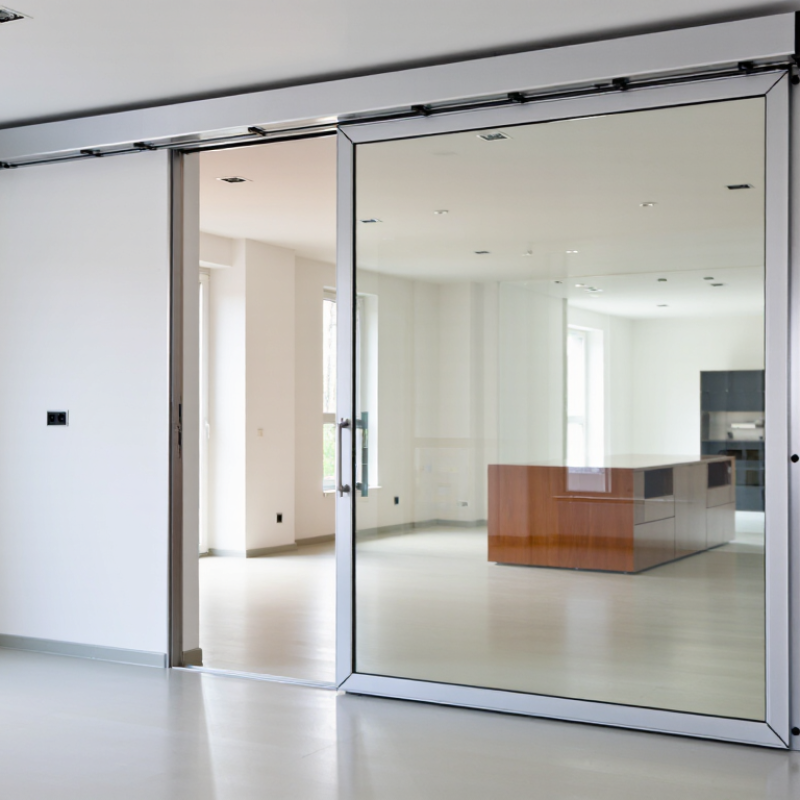
An aluminum hanging door is suspended from an overhead track instead of resting on a floor track. Its weight transfers upward through rollers, carriers, and the supporting ceiling or header. This arrangement keeps the floor nearly clear. It also helps reduce dust buildup around the doorway.
The basic structure includes an aluminum frame, door panel, top track, roller assemblies, floor guides, handles, and sealing strips. The frame holds the panel square. Rollers support and move it. Floor guides control swinging, but they should not carry the door’s main weight. A strong header is essential. The weak point is often the ceiling.
Aluminum provides low weight and good corrosion resistance. The International Aluminium Institute’s Aluminium Sector Greenhouse Gas Pathways to 2050 report identifies buildings as a major long-term market for aluminum. Its recycling research also notes that about 75% of all aluminum ever produced remains in use. That supports material recovery, but recycled content still depends on local collection systems.
For glazed hanging doors, sealing quality matters. The U.S. Department of Energy reports that windows can cause 25% to 30% of residential heating and cooling energy use. This figure does not directly describe doors. Still, it shows why glass, seals, and frame joints deserve attention.
A beautiful panel can perform poorly if the track sags or the seal is uneven. In practice, installers should check header strength, roller capacity, panel alignment, and clearance before final adjustment. Small errors become noisy movement.

What Is an Aluminum Hanging Door?
An aluminum hanging door is suspended from an overhead track instead of resting on floor rails. This design creates a clean opening and reduces contact with dust, water, and small debris. The door usually moves through rollers fixed inside or above the top frame. It suits interior partitions, offices, washrooms, and sheltered entrances.
Key Materials and Components
The main frame uses aluminum alloy because it is light, corrosion-resistant, and easy to shape. Alloy strength matters. A stronger profile can reduce bending across wide openings. The panel may contain tempered safety glass, wood-based boards, or composite sheets. Tempered glass improves impact resistance, while opaque panels provide privacy. Rubber or brush seals help limit drafts, vibration, and rattling. Small parts matter. Rollers, end stops, brackets, screws, and handle assemblies must match the door weight.
From installation experience, the ceiling or lintel needs enough strength to carry repeated movement. A hidden steel reinforcement may be necessary behind plasterboard. Rollers should sit evenly, or the panel may drift and scrape. A poor track joint can create a noticeable bump. I have seen carefully finished doors perform badly because installers ignored this detail. Accurate measurements also matter around skirting boards and uneven walls. Still, no door remains perfectly quiet forever. Dust can collect inside the track, and temperature changes may affect clearances. Regular cleaning and occasional fastener checks keep the system operating more reliably.
What Is an Aluminum Hanging Door?
How an Aluminum Hanging Door Operates
An aluminum hanging door moves from a track fixed above the opening. Rollers sit inside this track and carry the door panel. When pushed, the panel glides sideways instead of swinging on hinges. A floor guide limits movement and reduces shaking. Many systems also include soft-close devices, which slow the panel near its final position. The mechanism looks simple, but poor alignment creates noise, friction, and uneven gaps.
On site, installers usually check the track level before adjusting the rollers. A difference of only a few millimeters can make the door drift or stop early. Aluminum helps because it weighs roughly one-third as much as steel, according to U.S. Department of Energy material data. The International Aluminium Institute reports that around 75% of all aluminum ever produced remains in use. It also notes that recycling aluminum uses about 5% of the energy required for primary production. Still, lightweight does not mean maintenance-free. Dust inside the track can quickly affect operation.
Tips: Keep the upper track clean and inspect roller movement monthly. Do not force a dragging panel. Check the floor guide, fasteners, and closing speed first. For powered versions, safety testing should follow the applicable local requirements, including relevant guidance such as EN 16005. My practical concern is often overlooked: a beautiful frame cannot compensate for a weak wall or inaccurate installation.
An aluminum hanging door is suspended from an overhead track instead of resting on floor hinges. Its frame is usually lightweight, corrosion-resistant, and easy to operate. The track carries the door’s weight. Floor guides keep movement stable.
Common types include single sliding doors, bi-parting doors, telescopic doors, and folding systems. A single sliding door suits a narrow office entrance or a small room divider. Bi-parting doors open from the center, creating a wider passage for shops, meeting rooms, and clinics.
Telescopic models work well where wall space is limited. Folding versions can separate dining areas, patios, or commercial interiors without needing a large swing zone.
Applications vary with traffic, opening size, and environmental conditions. Interior aluminum hanging doors often divide offices, showrooms, kitchens, and clean work areas. In homes, they can separate a study from a living room while preserving light and visual openness. Outdoor models need suitable seals, drainage, and corrosion protection. Coastal air can expose weak finishes quickly.
Details matter. Installers should check the wall structure, track capacity, door weight, and clearance before ordering.
Soft-close hardware may improve safety and comfort, but it cannot correct a poorly aligned track. A door can look elegant and still perform badly. The term “hanging door” is also used loosely, so specifications deserve careful review. Some lightweight systems are not suitable for heavy security use or constant industrial traffic.
What Is an Aluminum Hanging Door?
An aluminum hanging door is supported by an overhead track rather than floor hinges. Its panels usually slide or fold along ceiling-mounted hardware. This design keeps the floor clear and suits garages, workshops, balconies, and interior openings. In daily use, the light frame feels easy to operate, especially where a heavy steel door would strain the track.
The main advantage is corrosion resistance. Aluminum handles humid air better than ordinary untreated steel, although its surface can still stain or oxidize. It also offers a clean appearance and moderate strength without adding excessive weight. Installation may require less floor preparation. However, the system depends heavily on accurate alignment. A slightly uneven track can cause rubbing, noise, or uneven movement. Aluminum can dent under a sharp impact. It also provides less insulation than a well-built insulated door, which matters in hot or cold rooms. I would not choose it only for appearance.
Maintenance is simple, but not optional. Inspect the overhead fasteners every few months, especially after strong wind or repeated daily use. Remove dust from the track with a soft brush, then wipe it with a damp cloth. Avoid abrasive pads, which can damage the finish. Check rollers for wobbling and listen for scraping sounds. Use only a lubricant suitable for the hardware, and apply it sparingly. Too much oil attracts grit. The practical lesson is easy to miss: a quiet door may still hide loose fixings, so visual checks should not replace professional inspection when movement becomes rough.
| Category | Key Point | Factual Description |
|---|---|---|
| Definition | What it is | An aluminum hanging door is a door system suspended from an overhead track or support structure. Its panels move by rolling or sliding along the upper track instead of relying primarily on floor-mounted hinges. |
| Main Components | Typical construction | Common components include an aluminum frame or panel, overhead track, rollers or hangers, guide hardware, handles, seals, fasteners, and optional locking or soft-closing devices. |
| Operating Principle | How it moves | The door’s weight is transferred to the overhead track through hangers or rollers. Floor guides may be used to control lateral movement and keep the panel aligned during operation. |
| Material Benefit | Lightweight structure | Aluminum generally has a lower density than steel, which can reduce the weight of the door panel and make manual operation easier when the track and hardware are correctly sized. |
| Corrosion Resistance | Performance in humid areas | Aluminum naturally forms a thin oxide layer that helps protect it from corrosion. Anodized or powder-coated surfaces can provide additional protection, but damage, salt exposure, and dissimilar-metal contact still require attention. |
| Space Efficiency | Clear floor area | Because the panel is suspended and usually slides parallel to the wall or opening, the system can avoid the floor swing area required by many hinged doors. The required side clearance depends on the opening and door configuration. |
| Installation | Structural support | The overhead structure must be strong, level, and properly anchored to support the door, track, and operating loads. Installation should follow the hardware manufacturer’s load ratings and fixing requirements. |
| Advantages | Ease of use | Smooth movement Low floor obstruction Lightweight panels Design flexibility When properly installed, the system can provide convenient access, efficient use of space, and a clean architectural appearance. |
| Advantages | Design flexibility | Aluminum can be formed into framed, glazed, louvered, or solid-panel designs. Surface finishes and infill materials can be selected according to appearance, light transmission, privacy, and environmental requirements. |
| Limitations | Track dependency | The overhead track and rollers are critical to performance. Dirt, misalignment, insufficient support, or worn rollers may cause noise, increased operating force, uneven movement, or premature wear. |
| Limitations | Sound and thermal control | A lightweight sliding or hanging design may provide less sound insulation and thermal separation than a properly sealed, heavy, hinged door. Actual performance depends on the panel, seals, joints, glazing, and installation quality. |
| Limitations | Security and privacy | Security and privacy depend on the lock, panel construction, track design, overlap, seals, and surrounding frame. A basic hanging configuration should not automatically be treated as a high-security or fire-rated assembly. |
| Environmental Suitability | Where it may be used | Typical applications include interior room dividers, offices, retail areas, residential spaces, light commercial openings, and selected exterior locations where the system is specifically designed for weather exposure. |
| Routine Maintenance | Cleaning schedule | Clean the door panel, track, guides, and hardware regularly with a soft cloth, mild detergent, and clean water. Remove abrasive particles and dry the surfaces afterward, especially in dusty, coastal, or industrial environments. |
| Routine Maintenance | Inspection points | Check track alignment, roller movement, fasteners, end stops, guide components, handles, locks, seals, and finish condition. Look for looseness, unusual noise, binding, scratches, oxidation, or gaps around the panel. |
| Lubrication | Correct practice | Use only a lubricant approved for the specific roller and track assembly. Do not apply excessive oil to areas that can collect dust, and do not lubricate components that the hardware instructions identify as dry-running. |
| Safety | Operational checks | The door should move smoothly without excessive force, sudden stopping, or derailment risk. Replace damaged rollers, guides, stops, or fasteners promptly, and keep children or users from hanging on the door panel. |
| Service Life | What affects durability | Durability depends on aluminum alloy and finish, panel weight, track capacity, installation accuracy, frequency of use, cleaning practices, moisture and salt exposure, and the quality of replacement hardware. |
| Recommended Use | Best choice when | An aluminum hanging door is most suitable when low floor obstruction, relatively light operation, flexible appearance, and straightforward access are more important than maximum acoustic insulation, high impact resistance, or heavy-duty security. |
You are using an outdated browser. Things may not appear as intended. We recommend updating your browser to the latest version.
Close