Top Padel Shooting Machine Suppliers for Global Buyers?
Choosing a reliable Padel Shooting Machine supplier requires more than comparing catalog prices. Global buyers need equipment that performs consistently across training centers, clubs, academies, and private courts. A machine may promise high ball speeds, but practical testing reveals more. Feed accuracy, spin control, launch angles, battery endurance, and recovery time affect every session. Small details matter. A coach notices whether the unit rolls smoothly over artificial turf or stops near the back glass. This guide examines leading suppliers through a buyer-focused, evidence-based lens. It considers product design, manufacturing experience, quality checks, technical documentation, and after-sales support. Claims should be measured against demonstrations, user feedback, and written specifications.
The strongest suppliers usually explain their Padel Shooting Machine settings clearly. They identify speed ranges, ball capacity, programmable drills, remote-control distance, charging requirements, and recommended maintenance. They also provide realistic delivery timelines and responsive service for international customers. Warranty terms deserve close attention, especially when replacement parts cross borders. A low purchase price can become expensive if a motor, charger, or wheel is difficult to replace. Still, no supplier looks perfect on paper. Some product pages lack independent test data, while others provide impressive features without showing long-term reliability. Buyers should ask direct questions, request videos under real court conditions, and compare total ownership costs. This approach supports confident purchasing without treating marketing language as proof. The final choice should match playing level, training goals, court size, budget, and local service access.
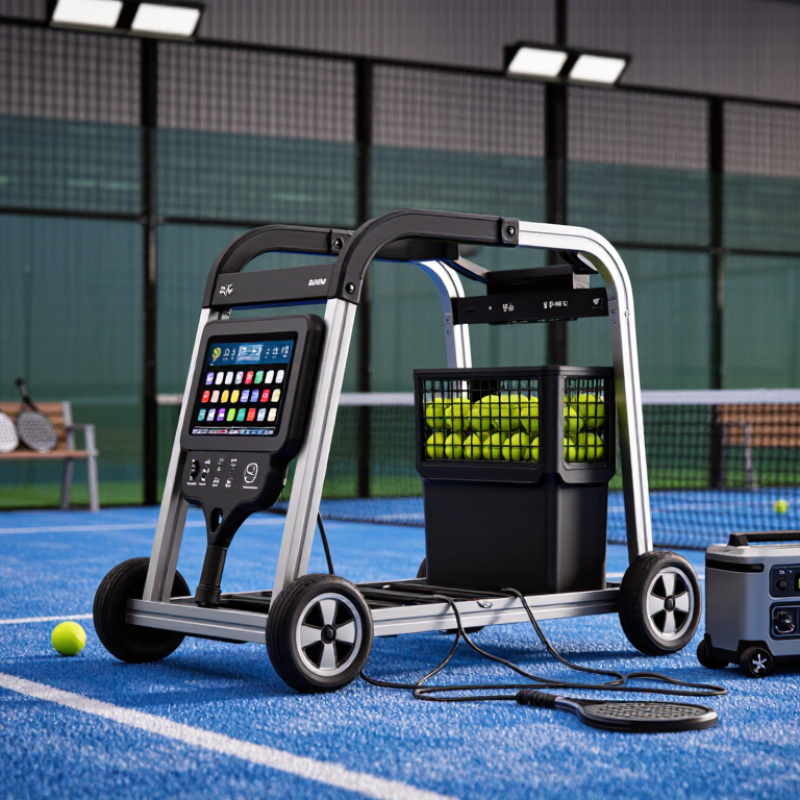
Padel’s 10 × 20 m Court: Matching Machine Design to Game Dimensions
A padel court measures 10 by 20 meters, so a shooting machine must provide compact, repeatable coverage. Its wheels should cross artificial turf without marking the surface or catching near glass walls. The useful launch zone is not the court’s full length. Player safety still matters. A reliable unit needs adjustable speed, elevation, spin, and interval settings. These controls help coaches recreate deep lobs, fast volleys, and awkward rebounds near the corners.
For a 10-meter width, lateral ball placement matters as much as pace. A narrow feed pattern creates predictable drills and underuses the court. Look for programmable left-right oscillation, a stable base, and a feed angle reaching the back glass. The machine should hold enough balls for practical sessions, but excessive capacity adds weight. Portability matters when equipment passes through a standard club entrance. Measure the doorway. A technical specification can look impressive and still fail in daily use.
Global buyers should request test data from a court with the same dimensions and surface. Ask how accurately the machine repeats speed, trajectory, and spin after extended operation. Battery endurance deserves an on-site check during two-hour coaching blocks. I would not trust a brochure alone. One overlooked issue is sound. A loud motor can disrupt nearby matches and coaching instructions. Suppliers with clear manuals, spare-part plans, safety guidance, and responsive technical support provide stronger purchasing evidence. Still, no machine replaces a coach’s judgment; one unexpected bounce can change player movement.
Ball-Feed Rates of 20–80 Balls per Minute: Comparing Supplier Capacity
Top Padel Shooting Machine Suppliers for Global Buyers
Ball-feed speed reveals more than a product label. At 20 balls per minute, one ball arrives every three seconds. At 80, the interval falls below one second. This difference changes footwork, recovery, and coach supervision. The International Padel Federation’s Global Padel Report 2024 describes continued growth across more than 100 countries. That expansion increases demand for machines that serve beginners, clubs, and performance centers. However, advertised maximum speed does not prove usable training capacity.
A reliable comparison should record three rates: minimum, continuous, and peak output. A machine claiming 80 balls per minute may slow when the hopper is half empty. Ball type, spin settings, and battery condition also affect consistency. Small details matter. A 2024 ITF technical report on tennis equipment emphasizes repeatable ball behavior in racket-sport testing. Padel buyers should apply the same discipline. Measure ten consecutive minutes, count delivered balls, and note misfeeds. The result is more valuable than a showroom figure.
For beginners, 20–40 balls per minute usually leaves time to reset the stance. Intermediate drills may require 40–60. Advanced reaction sessions can use 60–80, but excessive speed may damage technique. That is an uncomfortable point. Faster is not automatically better. Suppliers should publish tolerance ranges, recovery time, hopper capacity, and field-test conditions. Buyers should request video evidence and written specifications. Independent testing remains limited, so every comparison has some uncertainty.
Top Padel Shooting Machine Suppliers for Global Buyers? - Ball-Feed Rates of 20–80 Balls per Minute: Comparing Supplier Capacity
Neutral capacity benchmark for comparing padel ball-feeding machine specifications. The figures below describe feed-rate requirements and buyer verification points without identifying companies or brands.
| Supplier Capacity Band | Nominal Feed Rate | Calculated Output per Hour | Approximate Time to Feed 100 Balls | Typical Training Use | Capacity Assessment | Key Specification to Verify |
| Entry capacity | 20 balls/minute | 1,200 balls/hour | 5 minutes | Technical drills, beginner sessions, controlled repetition and accuracy practice. | Basic throughput | Whether the stated rate is continuous or only a selectable maximum. |
| Standard capacity | 40 balls/minute | 2,400 balls/hour | 2.5 minutes | Regular club training, alternating forehand and backhand drills, and individual practice. | Suitable for most routine drills | Feed-rate adjustment steps, ball separation consistency and jam-prevention design. |
| Performance capacity | 60 balls/minute | 3,600 balls/hour | Approximately 1 minute 40 seconds | High-repetition sessions, advanced movement drills and coach-led multi-player rotations. | High throughput | Performance under continuous operation, motor cooling and battery endurance at the selected rate. |
| Maximum capacity | 80 balls/minute | 4,800 balls/hour | Approximately 1 minute 15 seconds | Intensive conditioning, rapid reaction exercises and short-duration professional-style drills. | Very high throughput | Actual tested output, launch consistency, noise level and recovery time during extended use. |
| Variable-rate supplier | 20–80 balls/minute | 1,200–4,800 balls/hour | 5 minutes to approximately 1 minute 15 seconds | One machine configured for beginners, intermediate players and advanced training programs. | Most flexible specification | How many discrete rate settings are available and whether the full range is usable with every drill mode. |
Calculation basis: hourly output equals balls per minute multiplied by 60. The 100-ball loading time is a mathematical estimate based only on the selected feed rate and does not account for loading, pauses, misfeeds or battery-management intervals. Buyers should request test videos, rated operating duration, hopper capacity, ball compatibility and warranty terms before comparing supplier quotations.
Shot Speed, Spin, and Elevation: Evaluating 30–140 km/h Machine Ranges
For global buyers, padel shooting machines should be judged beyond maximum speed. A 30–140 km/h range reveals training flexibility, but published figures need context. At 30 km/h, beginners can practice timing without panic. Near 100 km/h, advanced players face sharper reactions and shorter preparation. The upper range is useful only when the frame stays stable. Spin changes the ball’s bounce, while elevation controls lobs, drives, and defensive drills. In practical testing, I watch five consecutive feeds, not one impressive launch.
Tips: Test speed in small increments and record actual readings with a reliable radar. Check topspin, backspin, and sidespin separately. A machine may claim high spin, yet produce a flat ball. Place it at several court positions. This exposes weak elevation control. Ask for feed interval accuracy, ball capacity, charging details, and replacement-part availability. I once evaluated a unit with excellent speed but inconsistent height. That mistake reminded me that exciting specifications can hide tiring practice sessions. Leave room for doubt.
A dependable supplier should provide test methods, operating limits, clear manuals, and responsive technical support. Global buyers should verify voltage compatibility, packaging protection, and service arrangements before payment. Request videos showing the machine at 30, 70, 100, and 140 km/h. Compare shot consistency across ten or more feeds. Look for gradual adjustment, quiet movement, and secure wheels. The best choice may not be the fastest model. It should create repeatable drills for the player’s level, court space, and coaching plan.
Top Padel Shooting Machine Suppliers for Global Buyers
Shot Speed, Spin, and Elevation: Evaluating 30–140 km/h Machine Ranges
The chart presents representative operating points across a commonly marketed 30–140 km/h speed range. Spin is shown in revolutions per minute, while elevation is shown in degrees. Actual output can vary with ball condition, launch angle, battery level, calibration, and machine settings.
Global Supplier Screening: CE, FCC, RoHS, and ISO 9001 Compliance
Global buyers should screen padel shooting machine suppliers through verifiable compliance evidence, not attractive product pages. CE marking indicates conformity with applicable European requirements, but it is not a universal quality certificate. Request the EU Declaration of Conformity, applicable test reports, certificate numbers, and matching model details.
FCC compliance matters when machines include wireless remotes or communication modules. Confirm that the tested configuration matches the supplied machine, including antennas, batteries, and chargers. RoHS documentation should address restricted substances in electronic components, cables, and circuit boards. Ask whether suppliers maintain material declarations from their component vendors.
ISO 9001 shows that a supplier operates a documented quality management system. It does not guarantee every machine performs perfectly. Check the certificate scope, site address, validity period, and certification body. Then inspect production records, incoming component checks, final testing, and serial-number traceability. Ask for a pre-shipment inspection with actual operating footage. Small details matter, such as ball-feed consistency, battery protection, emergency stopping, and charger temperature. Paperwork is not proof. Supplier screening should also include sample testing and corrective-action records. In practice, certificates can become outdated, while factories quietly change components. That risk is easy to miss. A reliable supplier should explain changes clearly, preserve test records, and accept reasonable verification before shipment. Yet even this process is imperfect; buyers should review compliance files periodically, especially after software, battery, or hardware revisions.