China Top 10 Girder Crane Manufacturers for Global Buyers?
For global buyers, selecting among China’s top 10 girder crane manufacturers requires more than comparing prices. Girder Cranes must match the real working environment. That includes lifting capacity, span, duty class, travel speed, workshop height, and operating temperature. A 20-ton crane moving steel coils needs different protection than one serving a clean assembly line. Small details matter.
Dr. John W. Hinze, a respected construction-safety researcher, emphasized a principle that applies strongly here: “Safety performance is not accidental; it reflects management commitment and daily control.” Buyers should therefore examine design calculations, welding procedures, component traceability, factory testing, and inspection records. ISO, EN, and national standards may support confidence, but certificates alone cannot prove manufacturing quality. Ask for load-test reports. Review maintenance instructions. Check the supplier’s response time for spare parts.
This guide compares ten leading Chinese manufacturers through practical buyer concerns. These include engineering capability, export experience, customization, documentation, after-sales support, and total ownership cost. Factory visits and customer references can reveal details that brochures often hide. Rust near a control cabinet matters. So does unclear wiring.
No ranking is perfect. A strong manufacturer for a steel mill may not suit a smaller warehouse. Exchange rates, shipping conditions, local installation skills, and regional service networks can also change the final decision. Global buyers should use this list as a structured starting point, not as a final verdict. The safest purchase is usually the one supported by clear evidence, realistic specifications, and disciplined communication.
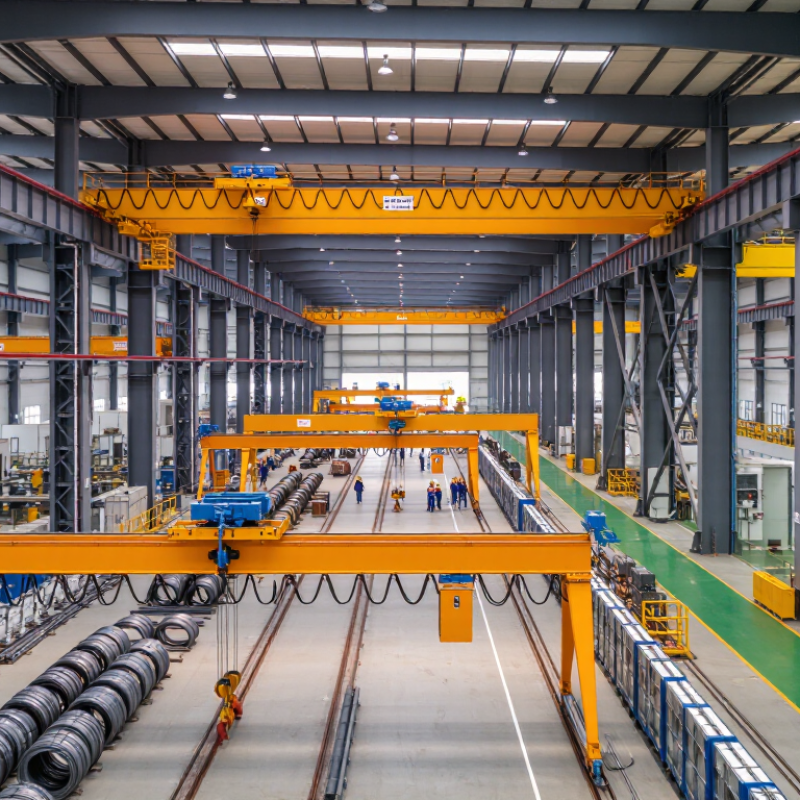
What Is a Girder Crane and Where Is It Used?
A girder crane is an overhead lifting system built around one or more horizontal girders. The girders support a trolley, hoist, bridge drive, and end trucks. The hoist moves vertically, while the trolley travels across the bridge. The entire crane can move along runway rails fixed to a building structure.
In real facilities, girder cranes handle steel coils, machinery, molds, containers, and maintenance parts. They are common in factories, warehouses, shipyards, power facilities, and construction workshops.
Single-girder designs suit moderate loads and shorter spans. Double-girder models provide greater lifting capacity, hook height, and stability.
Selection depends on load weight, lifting frequency, span, travel distance, indoor conditions, and available headroom. A detailed load chart matters more than a simple capacity label. That point is easy to overlook.
For global buyers, technical documents should include drawings, motor data, control details, duty classification, inspection records, and spare-part information. Experienced engineers also check runway alignment, foundation strength, emergency stopping, and operator visibility. No design is perfect for every workshop. Humidity, dust, heat, and uneven usage can change performance over time.
Tips: Measure the building before requesting a quotation. Confirm the maximum load, not just the usual load. Ask how overload protection and routine inspections are managed. Leave safe clearance around the hook path. A cheaper crane may create higher maintenance costs later.
How to Evaluate Chinese Girder Crane Manufacturers
Evaluating Chinese girder crane manufacturers requires more than comparing prices. Start with the factory, not the brochure. Check production capacity, welding areas, machining equipment, and material storage. A clean workshop is useful, but it is not proof of quality. Ask for recent project records with similar span, lifting capacity, duty class, and operating environment.
Review engineering documents carefully. Reliable manufacturers should provide load calculations, drawings, welding procedures, inspection plans, and electrical schematics. Confirm whether materials have traceable certificates. Inspect weld quality through documented visual checks and suitable non-destructive testing. Factory acceptance testing should include no-load movement, limit switches, emergency stops, brake performance, and rated-load testing. Short videos help, but witnessed testing is stronger evidence.
Export experience also deserves close attention. Verify packing methods, installation guidance, spare-parts lists, and response times for technical support. Ask how the manufacturer handles design changes after approval. That detail often exposes weak project control. A low quotation may exclude commissioning, training, or replacement parts. Request a complete cost breakdown. Do not rely on one reference. Contact several previous buyers and ask about delivery accuracy, defects, and support after installation. Some suppliers may communicate confidently while missing small engineering details. Leave room for independent inspection and technical review. Mistakes happen, even in experienced factories. Reliability comes from visible controls, honest documentation, and accountable follow-up.
China’s Top 10 Girder Crane Manufacturers for Global Buyers
China’s Top 10 Girder Crane Manufacturers for Global Buyers
China remains a major sourcing base for girder cranes used in factories, ports, warehouses, and steel plants. Allied Market Research reported that the global overhead crane market could reach about USD 8.1 billion by 2032, supported by industrial automation and infrastructure investment. This growth increases buyer interest in Chinese engineering capacity, but rankings should not rely on production volume alone.
A reliable evaluation checks lifting capacity, span, duty class, control systems, and documented testing. The ISO 9001 framework supports consistent quality processes, while EN 15011 and FEM classifications help buyers compare crane design and operating duty. Factory audits should examine welding records, gearbox alignment, emergency stops, and load-test procedures. Small details matter.
Look closely at after-sales support.
According to MarketsandMarkets, automation and smart monitoring are becoming important trends across the material-handling equipment sector. Buyers should therefore ask whether a girder crane supports remote diagnostics, overload protection, variable-frequency drives, and replacement-part planning. Export experience also matters because drawings, manuals, electrical standards, and inspection documents must match the destination country. A low quotation may seem efficient, yet it can hide weak commissioning support or unclear warranty terms. I would also question rankings that provide no test evidence, service records, or transparent factory data. That gap is easy to overlook.
Key Products, Certifications, and Export Capabilities
For global buyers comparing the top ten girder-crane manufacturers, product evidence matters more than polished catalogs. The global crane market was valued at about USD 34.8 billion in 2023, according to Fortune Business Insights. Demand is rising across factories, ports, steel plants, and warehouses. A serious supplier should disclose rated load, span, lifting height, duty class, trolley speed, and tested load records. “Heavy duty” is not a measurable specification.
Key products usually include single-girder, double-girder, gantry, and explosion-protected configurations. Buyers should check alignment with ISO 4301, EN 15011, FEM classifications, or applicable national standards. ISO 9001 supports controlled production, while ISO 14001 and ISO 45001 indicate environmental and occupational safety systems. CE marking may support European access, but it does not replace a complete conformity assessment. Documentation matters.
Export capability is visible in details. Look for serial-numbered components, multilingual manuals, spare-part lists, packing photographs, and factory acceptance test reports. UN Comtrade trade data shows how strongly machinery exports depend on reliable transport networks and customs documentation. Suppliers should explain HS codes, Incoterms, warranty response times, and remote commissioning. Certificates can still be incomplete. That gap is real. Independent inspection before shipment is often worth the extra cost, especially when a crane will operate continuously or handle high-value production materials.
How to Compare Prices, Support, and Supplier Reliability
Comparing China’s top ten girder crane manufacturers requires more than checking the lowest quotation. A reliable comparison starts with matching technical details, including lifting capacity, span, duty class, control method, and installation conditions. A cheaper offer may exclude rails, testing, spare parts, or operator training. Request an itemized price sheet. Small omissions can become expensive later.
Supplier experience becomes visible in the details. Ask for drawings, load calculations, factory inspection records, and references from similar projects. Photos help, but signed inspection documents provide stronger evidence. I would also compare motor efficiency, structural steel standards, coating thickness, and component availability. Some suppliers respond quickly before payment, then communicate slowly during production. That risk deserves attention.
Support should be measured in practical terms. Confirm response times, remote troubleshooting methods, warranty coverage, and local service options. Ask who pays for replacement parts and travel costs. A video inspection before shipment can reveal poor welding, damaged cable systems, or missing labels. Factory visits are useful, though not always decisive. I have seen polished workshops and imperfect documentation. That contradiction requires careful questions. Payment milestones should follow measurable progress, such as approved drawings, completed assembly, and passed load testing. Supplier reliability is built through evidence, not confident promises.
China Top 10 Girder Crane Manufacturers for Global Buyers? – How to Compare Prices, Support, and Supplier Reliability
Anonymized comparison based on commonly published product ranges, export practices, technical support coverage, and buyer-oriented evaluation criteria
| Rank | Supplier Code | Main Production Region | Typical Capacity Range | Typical Span Range | Indicative FOB Price* | Typical Lead Time | Warranty | Export Support | Quality Documentation | Reliability Score |
| 1 | Supplier 01 | Jiangsu / Anhui industrial belt | 10–100 t | 10–35 m | US$18,000–95,000 | 35–55 days | 12–18 months | High | CE, ISO 9001, load-test records | 9.2/10 |
| 2 | Supplier 02 | Henan lifting-equipment cluster | 5–80 t | 8–32 m | US$15,000–82,000 | 30–50 days | 12 months | High | CE, ISO 9001, FAT available | 9.0/10 |
| 3 | Supplier 03 | Shandong manufacturing region | 5–75 t | 10–30 m | US$16,500–78,000 | 40–60 days | 12 months | High | CE, ISO 9001, material certificates | 8.8/10 |
| 4 | Supplier 04 | Zhejiang coastal industrial zone | 3–50 t | 8–28 m | US$14,000–65,000 | 30–45 days | 12 months | Medium–High | CE, ISO 9001, inspection checklist | 8.6/10 |
| 5 | Supplier 05 | Hubei central manufacturing area | 5–100 t | 10–36 m | US$19,000–105,000 | 45–70 days | 12–18 months | Medium–High | CE, ISO 9001, welding records | 8.4/10 |
| 6 | Supplier 06 | Jiangxi industrial region | 3–50 t | 8–26 m | US$13,500–61,000 | 35–55 days | 12 months | Medium | CE, ISO 9001, basic test reports | 8.1/10 |
| 7 | Supplier 07 | Fujian coastal manufacturing area | 2–40 t | 7–24 m | US$12,500–52,000 | 30–50 days | 12 months | Medium | CE, ISO 9001, packing records | 7.9/10 |
| 8 | Supplier 08 | Hebei northern industrial region | 5–80 t | 10–30 m | US$16,000–84,000 | 45–65 days | 12 months | Medium | CE, ISO 9001, dimensional report | 7.8/10 |
| 9 | Supplier 09 | Guangdong export-oriented region | 2–35 t | 7–22 m | US$11,500–49,000 | 35–55 days | 12 months | Medium | CE, ISO 9001, export packing list | 7.6/10 |
| 10 | Supplier 10 | Liaoning heavy-equipment region | 10–120 t | 12–40 m | US$24,000–125,000 | 55–80 days | 12–18 months | Medium | CE, ISO 9001, full inspection package | 7.5/10 |
*Price note: Indicative FOB price ranges are intended for preliminary budgeting only. Actual quotations vary according to lifting capacity, span, duty class, power supply, control system, runway length, accessories, testing requirements, packing, and destination.
Evaluation note: Reliability scores should be validated through factory audits, recent customer references, third-party inspection, component traceability, contract terms, spare-parts availability, and documented after-sales response times before purchase.