How to Source Custom Soap Dish Holders from China?
How to Source Custom Soap Dish Holders from China?
Sourcing a custom soap dish holder from China requires more than comparing factory prices. Product details must be checked closely. A buyer should define the material, dimensions, drainage design, finish, logo method, and packaging before requesting quotations. Ceramic, bamboo, stainless steel, and plastic each need different quality controls.
Mike Bellamy, founder of PassageMaker and a China-sourcing specialist, offers a practical warning: “The best supplier is the one that communicates clearly when a problem appears.” This principle matters when developing a Soap Dish Holder Custom China project. A reliable factory should explain its molding process, sample timeline, minimum order quantity, and inspection standards without avoiding difficult questions.
Ask for a physical sample. Check its weight, glaze consistency, drainage slots, rubber feet, and edge smoothness. Place it beside a wet bar of soap. Does water escape quickly? Does the holder remain stable on a polished sink? Small details affect customer reviews and return rates.
Factory photos are not enough. Request recent production videos, test reports, carton specifications, and clear payment terms. Independent inspections can reduce avoidable risks. Still, no sourcing plan is perfect. Samples may pass while mass production changes slightly. I have seen buyers focus too heavily on unit cost and overlook inner packaging. That mistake can turn attractive products into chipped deliveries.
This guide explains how to evaluate Chinese suppliers, control customization, negotiate responsibly, and build a repeatable purchasing process for soap dish holders.
Define Your Custom Soap Dish Holder Requirements
How to Source Custom Soap Dish Holders from China?
Define Your Custom Soap Dish Holder Requirements
A successful sourcing project begins with a precise product brief. I learned this after receiving a sample that looked attractive but held too much water. Define the holder’s length, width, height, and weight before contacting suppliers. Include a simple drawing with measurements in millimeters. State the number of drainage holes and their exact positions. Small details matter.
Choose the material according to bathroom conditions and target pricing. Ceramic offers a refined appearance, while stainless steel provides strength and easy cleaning. Silicone can protect countertops from scratches. Specify the surface finish, color reference, logo method, and acceptable color variation. Matte finishes may show soap residue more clearly. That detail is easy to miss.
Consider how the holder will be packed and tested. Request drop-test expectations, moisture resistance checks, and inspection standards for cracks, sharp edges, stains, and uneven coatings. Ask for a physical sample before approving mass production. Compare its stability on wet stone, glass, and ceramic surfaces. It should not slide when pressed with a wet bar of soap. My early requirements ignored packaging space, which increased shipping volume. That mistake deserves attention. Include carton dimensions, inner protection, barcode placement, and the required quantity per carton. Share regional safety and labeling requirements with the supplier, then confirm them in writing.
Find and Screen Suitable Chinese Manufacturers
Custom soap dish holders look simple, but sourcing them well requires disciplined screening. The right Chinese manufacturer should understand drainage, glaze consistency, packaging, and repeat production. I begin with a clear product brief covering dimensions, material, finish, color tolerance, target quantity, and packaging. Send drawings first. Reference photos also help reduce misunderstandings about curves, slots, and surface texture.
I usually compare several manufacturers, not just the lowest quotation. I request their business registration details, factory address, production capacity, and recent workshop photos. A live video call can reveal useful details, such as kiln size, molding equipment, and storage conditions.
Ask whether molding, firing, glazing, and assembly happen in-house. Outsourcing is not automatically a problem, but unclear responsibility creates delays. Confirm minimum order quantity, sample fees, tooling costs, lead time, and payment stages in writing.
Samples deserve careful testing. Place the holder on a wet counter and check drainage, stability, sharp edges, staining, and water absorption. Measure the sample against the approved drawing, because small changes can affect retail packaging. My early mistake was trusting a polished prototype without testing its carton protection. Several pieces arrived chipped during transit. Now I request a packing sample and a pre-shipment inspection. Independent inspection is helpful, though it cannot replace a detailed specification. Keep approved samples, inspection photos, and signed records for every production run. A reliable supplier should accept reasonable corrections without becoming defensive. That attitude matters.
Compare Samples, Materials, Pricing, and Customization Options
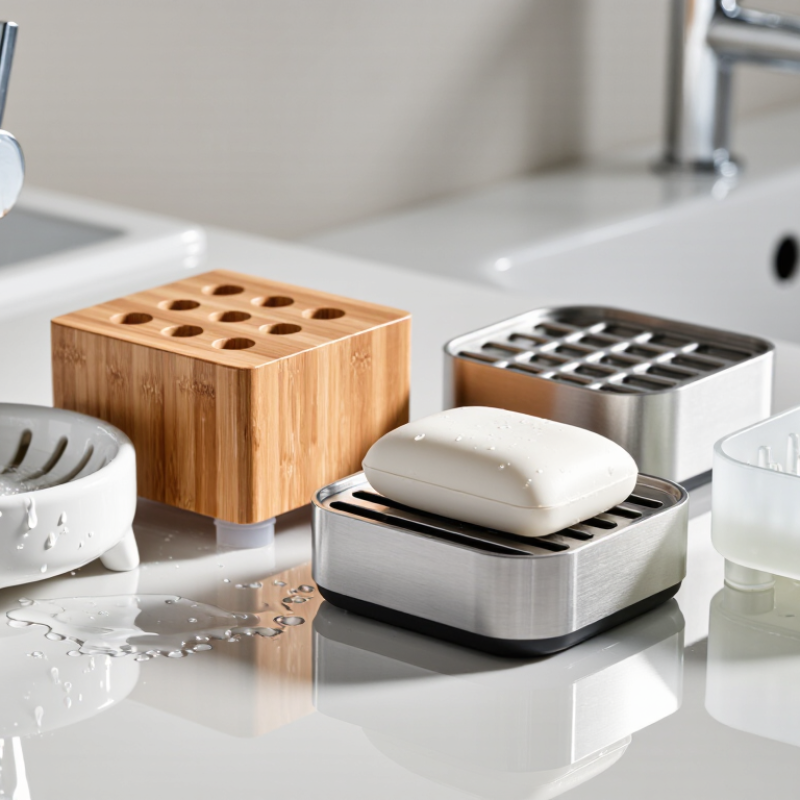
When sourcing custom soap dish holders from China, compare physical samples before negotiating price. A glossy ceramic sample may look refined, yet its drainage holes can trap water. Test each holder beside a sink for seven days. Check wobbling, glaze consistency, edge smoothness, odor, and drying speed. Also inspect packaging strength after a drop test. Materials create different trade-offs. Ceramic offers weight and color depth. Stainless steel resists moisture but may show fingerprints. ABS and PP reduce cost and breakage risk. Bamboo feels natural, but repeated wet use can cause swelling without proper sealing.
Pricing should separate sampling, tooling, unit cost, packaging, and inspection fees. Small orders often receive higher unit quotations, while larger production runs reduce mold and labor costs. Request the same specification from three factories. Compare material weight, wall thickness, drainage design, and carton protection, not only the headline price. The OECD Global Plastics Outlook reported 353 million tonnes of plastic waste in 2019, roughly double the 2000 level. This supports asking for recycled content evidence, but certification claims still require verification. A low-cost recycled plastic sample may have uneven color or weaker structure. That is easy to overlook.
Customization can include logo placement, Pantone color matching, private molds, suction feet, drainage trays, and retail boxes. Ask for mold ownership terms and pre-production approval in writing. I would not approve a large order from photographs alone. Small details matter. Supplier inspection reports, material declarations, and batch photos improve reliability. Mistakes still happen. Allow time for one correction round.
How to Source Custom Soap Dish Holders from China?
Indicative China factory-sourcing benchmarks for common soap dish holder materials. Ceramic and stainless steel generally offer higher durability and customization potential, while plastic and bamboo typically provide lower entry costs. Hover over each bar to compare sample lead time, typical MOQ, and custom production timing.