Essential Tips for Mastering the Injection Molding Process?
The injection molding process is a cornerstone of modern manufacturing. It shapes materials into precise forms, driving industries from automotive to consumer goods. According to a report by MarketsandMarkets, the global injection molding market is projected to exceed $300 billion by 2025. Such growth highlights its importance in today's economy.
Expert Peter G. Singh, a renowned figure in polymer engineering, emphasizes the significance of mastering this process. He states, "Success in injection molding lies in understanding the nuances of material behavior." This insight points to the complexity of the injection molding process. Factors like temperature, pressure, and material selection demand careful consideration.
Even seasoned professionals can find challenges in this field. Missteps in the injection molding process can lead to defects and wasted resources. Learning from these errors is crucial. Each failure presents an opportunity for improvement, driving innovation and efficiencies. Mastery is not just about technique; it involves continuous learning and adaptation.

Understanding the Basics of Injection Molding: Key Concepts and Terminology
Understanding the injection molding process is crucial for both novices and experienced professionals. The process starts with heating polymer pellets until they melt. This molten plastic is then injected into a mold cavity under high pressure. Proper temperature control is essential. A recent report indicated that 15% of production issues arise from inadequate temperature management.
Key terminology is often overlooked. For instance, “fill time” refers to how long it takes for the injection to fill the mold. Too fast can lead to defects, while too slow may cause inconsistent parts. It's notable that around 30% of molding defects relate to improper fill patterns.
Another concept is the “cooling time.” This is the period required for the injected material to solidify. It typically constitutes 40-60% of the cycle time. Understanding these nuances can drastically improve production efficiency. Yet, many professionals fail to analyze these stages adequately. Continual reflection on these practices is necessary for mastering injection molding.
Choosing the Right Materials for Injection Molding: A Comprehensive Guide
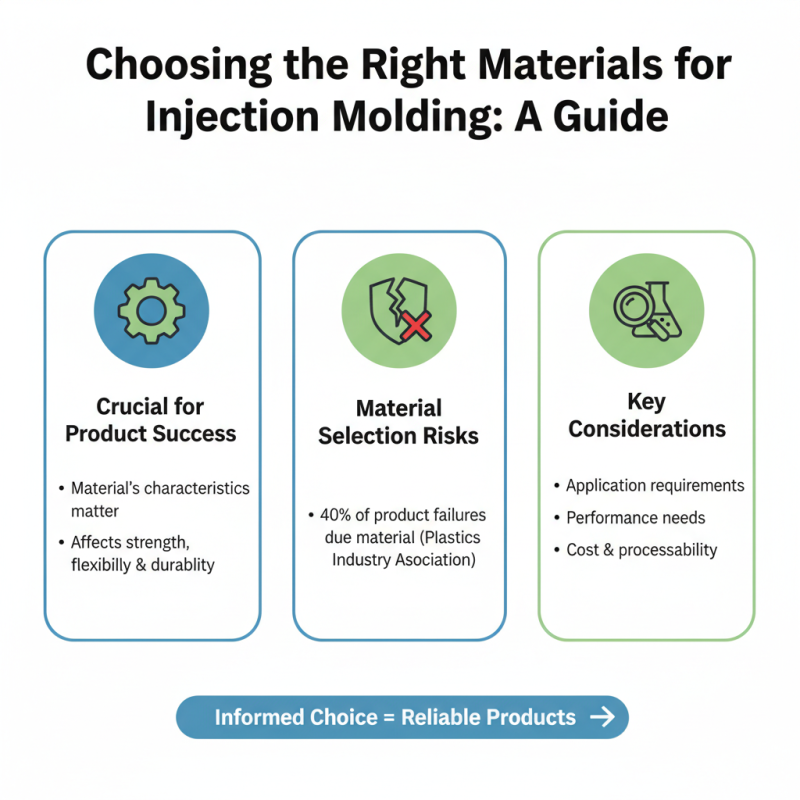
Choosing the right materials for injection molding is crucial. The success of a product hinges on the material's characteristics. Materials can affect strength, flexibility, and durability. For instance, according to a report by the Plastics Industry Association, about 40% of product failures are linked to material selection.
When selecting materials, consider factors such as tensile strength and impact resistance. Polypropylene and ABS are popular due to their versatility. They offer good mechanical properties and ease of processing. However, these materials might not perform well under extreme temperatures. Always consult material data sheets for detailed insights.
Tip: Test different material samples. This allows for better understanding of performance under real-world conditions. Use design simulations to predict how materials behave during the molding process.
It's also essential to reflect on sustainability. Many manufacturers are shifting towards bio-based and recycled materials. While they may be more environmentally friendly, their performance can vary. A recent study showed that recycled materials often lead to inconsistencies in end products. This risk should guide your decision-making.
Tip: Stay updated with material trends. Attend industry seminars and webinars to gain knowledge. Peer insights can enhance your understanding of materials in today's market.
Optimizing the Injection Molding Process: Techniques for Efficiency and Quality
Optimizing the injection molding process is vital for enhancing overall efficiency and product quality. Studies show that streamlined operations can reduce production time by up to 30%. This not only improves throughput but also cuts down costs. One effective technique involves carefully selecting the right material for your application. Utilizing advanced polymers can often improve the final product's durability and visual appeal.
Tips for mastering this process include thorough preparation and machine calibration. Maintaining consistent temperatures is crucial. Fluctuations can lead to defects. Research indicates that a temperature variation of more than 5 degrees Celsius can increase scrap rates by 15%. Implementing a robust quality control system is also essential. Regular inspections can help catch issues early in the production cycle.
Another key component is the design of the mold itself. Complex geometries can create challenges in the molding process. Designers should consider ease of ejection and cooling efficiency. Incorporating tools for simulation can aid in identifying potential problems before production begins. This approach can save significant time and resources. Addressing these factors can drastically improve efficiency and quality in injection molding.
Troubleshooting Common Issues in Injection Molding: Best Practices
Injection molding is a complex process. Even experienced operators can face challenges. Common issues include defects like warping, short shots, and surface flaws. Each problem requires careful investigation to identify causes and solutions.
Warping often occurs due to uneven cooling. Maintaining consistent temperatures is critical. Adjust the cooling time or temperature settings to mitigate this issue. Short shots may arise from insufficient material injection. Check your machine’s settings and material feed to ensure an adequate supply. Surface flaws can stem from contamination or tool wear. Regular maintenance of molds and ensuring cleanliness can help avoid these defects.
Analyzing failures is essential. It’s a learning opportunity to refine processes. Documenting issues and resolutions also builds knowledge. A proactive approach enhances reliability in the injection molding process. Every setback can lead to better practices. The goal is to achieve consistent quality and efficiency.
Essential Tips for Mastering the Injection Molding Process - Troubleshooting Common Issues in Injection Molding: Best Practices
| Issue |
Description |
Possible Causes |
Solutions |
| Short Shots |
Incomplete filling of the mold |
Low injection pressure, improper temperature, insufficient material |
Increase injection speed and pressure, adjust melt temperature |
| Warpage |
Deformation after cooling |
Uneven cooling, mold design flaws |
Optimize cooling channels, adjust mold design |
| Bubbles |
Air pockets in the molded part |
Moisture in material, low vacuum pressure |
Dry material properly, enhance vacuum systems |
| Surface Defects |
Imperfections on the part surface |
Dirty molds, incorrect processing parameters |
Clean molds regularly, fine-tune processing settings |
| Flash |
Excess material at the parting line |
Too high injection pressure, poor mold fit |
Reduce injection pressure, improve mold alignment |
Innovations in Injection Molding Technology: Future Trends to Watch
The world of injection molding is evolving rapidly. Innovative technologies are reshaping this industry, driving efficiency and sustainability. As per a recent report by MarketsandMarkets, the global injection molding market is expected to reach $271 billion by 2026. This growth reflects a shift towards advanced materials and smart manufacturing processes.
One significant trend is the adoption of Industry 4.0 principles. Factories now leverage IoT devices and big data analytics. These technologies provide real-time insights into machine performance and product quality. However, this transition isn't flawless. Companies often face challenges in integrating new systems with legacy equipment. Such gaps can lead to production inefficiencies, highlighting the need for careful planning and execution.
Another notable innovation is the emergence of bio-based and recycled materials. These materials reduce dependency on fossil fuels and lower carbon footprints. A study from the American Society of Mechanical Engineers noted that bio-based materials could decrease CO2 emissions by up to 40%. Yet, the performance of these materials often lags behind conventional options. This creates a dilemma between sustainability and product reliability. As the industry moves forward, finding the balance between efficiency, quality, and environmental impact will be crucial.